
July 23 - August 4 2000,
Sponsored by Michael Aw (Ocean Environment)
The expedition took place off the coast of East Kalimantan on the Baruna Adventurer, a live aboard dive boat chartered from Bali, Indonesia. Participants included Dive enthusiasts, top Underwater Photographers and Cameramen as well as Researches. Michael Aw invited 'Earth Advocates' representative Robin Marinos with the purpose of making a general assessment of the reef conditions, including fish count of various species, to record the unique attributes of various remote areas and specifically, record Sea Turtle distribution within the areas being visited. This assessment coincides with the broad agenda of Earth Advocates to discover and seek long term protection of natural ecosystems and the species within.
 The
expedition members met in Balikpapan July 22nd, 2000.
The following day, all equipment was loaded onto the Baruna
Adventurer before the team departed from Balikpapan Harbor,
the heart of the Indonesia's Oil industry. An area, where the
waters are visibly scarred and polluted by the effects of the
Oil Industry. The general assessment of this expedition will
be discussed in accordance to movement and the relevant issues.
The
expedition members met in Balikpapan July 22nd, 2000.
The following day, all equipment was loaded onto the Baruna
Adventurer before the team departed from Balikpapan Harbor,
the heart of the Indonesia's Oil industry. An area, where the
waters are visibly scarred and polluted by the effects of the
Oil Industry. The general assessment of this expedition will
be discussed in accordance to movement and the relevant issues.
The first destination was North of the Makassar Strait to Birah-birahan , from that point on the expedition moved northwards toward the Berau area, stopping to dive at locations around 18 remote islands and submerged reefs. The main focal areas were dive locations within the Berau Area, diving an average of 3-4 times a day for 10 days. It was up to the participants own judgment as to how many dives they made at particular sites within the framework of the expedition. Earth Advocates representative made 25 dives and 3 snorkel trips, spending up to 3 hours a day in the water, exploring depths down to 40 meters, with the average depth approximately 12 meters. Earth Advocates will generally review its observations and findings in this report concerning the Makassar Strait Expedition.

Photographer,
Joerg Malke, getting close-ups of Cuttle-fish during the Expedition
General Reef Conditions
Many observations of reef conditions and existing genera were made during dives, leading to certain assessments, often after consultation with other members of the expedition. The observations and assessments will be reviewed in the order of relevance to the particular subject matter(s) being discussed within this report. This fact finding expedition purposely targeted various unprotected remote reef areas to explore their general conditions due to their relative importance to the healthy survival of the Indonesian Archipelago. The following general observation have been made to be followed by the main points and conclusions.
Non
protected remote islands and areas including submerged reefs
such as Karang Lintang, located southeast of the Berau
area approximately North 1º59', East 118º52',
was extensively damaged especially in the  shallower
parts of the reef. We also found large alleys of destroyed
reef following down to the lowest levels. There was extensive
evidence of dynamite destruction, bubu trap fishing and other
destructive methods of fishing. Due to massive reef destruction,
there exists an obvious lack of fish species, especially targeted
larger fish, as Shark, Napoleon Wrasse, and Grouper, plus the
smaller colorful ornamental fish.
shallower
parts of the reef. We also found large alleys of destroyed
reef following down to the lowest levels. There was extensive
evidence of dynamite destruction, bubu trap fishing and other
destructive methods of fishing. Due to massive reef destruction,
there exists an obvious lack of fish species, especially targeted
larger fish, as Shark, Napoleon Wrasse, and Grouper, plus the
smaller colorful ornamental fish.
The sight seen much to often in the Indonesian Archipelago, systematic destruction of targeted species.
Other uninhabited and unprotected areas such as the northwest side of the Island Birah-birahan, also showed massive damage resulting from destructive fishing methods. Surprisingly, on the southeastern side, the main reef as well as the attached submerged reef mounds had an abundance of sea life and generally undamaged soft and hard corals. In fact, one of the most impressive dive sites of the whole trip was an area that had obviously not been discovered and pillaged by fishermen and the live fish trade. (I recommend that the government protect these reefs in addition to the reefs of Derawan, which are further north within the Berau area).
In the case of Tanjung Labuanbini along the coast eastward from Teluk Sangkuriang (the bay of Sangkuriang), we found a high proportion of living soft corals compared to hard corals. Visibility was very poor, at times down to less than 3m. The amount of silt carried by the current was very high. We believe that silt runoff from the mainland's waterways had displaced itself among susceptible hard corals, whereas soft corals easily moved by the strong current were surviving the silt build up thus able to breath. This reef was marred with deficiencies as the lack of certain species of fish, similarly depleted from other reefs. Namely those species specifically targeted for the 'Live Fish Trade'.
On the second day we reached the borderline area of Berau, the Matah Island region, and found a navy coast guard boat moored there. We later established that this is one of the particular areas where the Navy monitor ship movements and irregular activities such as pirating and illegal fishing practices. We consider this a Partially protected area due to this fact that the Navy's presence reduces the chances of illegal and destructive fishing occurring despite not having the Marine Park status. This seemed to reflect on the general condition here. We found the coral to be in relatively good condition, although there were some spots of damage. Some of the damage found was patches of bleached skeleton coral, a typical sign of Cyanide fishing. We also noticed areas where large pieces of coral had been torn out. Our overall impression was that this area, containing a high variety and abundance of soft and hard corals, if protected could sustain a balanced environment. The cancerous damaged areas could also recover, time allowing.
 A
Cuttlefish hovering over an area of totally damaged Hard
Coral, the situation witnessed much to often in remote areas!
A
Cuttlefish hovering over an area of totally damaged Hard
Coral, the situation witnessed much to often in remote areas!
Only
a few kilometers north-east of Matah, around Bilang-bilangan Island
we found discouraging evidences that imply the need for immediate
reef protection. The initial observation made was that there
were two medium sized fishing boats. Later we discovered that
they were running small boats with attached machinery known
as Hookah compressors. We found aboard the mother boat
10 to 20 sedated Brown Spotted Groupers weighing between 4-10
kg. Although it was stated by the captain that they were using
nets, there were none visible, only small boats with compressors,
hoses and canisters.
As we approached the two boats, one of them,
conveniently covered, suspiciously moved away. We believe that they
were avoiding our possible detection and discovery of some sort of
evidence of illegal fishing practices.
This contradiction to the Matah situation demonstrated that without full protection of any area, one could expect that these damaging and illegal fishing practices would persist, especially if the Navy is not present. Therefore whatever assessments made now about the reef conditions, one would find less favorable conditions with time unless the appropriate law enforcement procedures were undertaken.
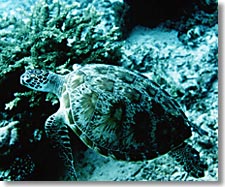 The
comparison further established
that the reef of Bilang-bilangan, had increased signs of damage.
We found similar types of species, however less in numbers.
The only exception was a high number of turtles homing
and roaming in the area.
The
comparison further established
that the reef of Bilang-bilangan, had increased signs of damage.
We found similar types of species, however less in numbers.
The only exception was a high number of turtles homing
and roaming in the area.
This evidently a turtle breeding ground, leading
to the assumption and suspicion that the covered boat we had spotted
earlier was likely to be carrying illegally captured turtles. This
boat similar to other Turtle transporting boats used by Turtle dealers
of the renown Tanjung, Bali Sea Turtle Slaughter Grounds.
Moving further north to Sambit Island and the surrounding submerged reefs , we found a large variety of hard and soft corals, fish species and other diverse sea life forms. Unfortunately we also noticed massive damage and erosion, evidence of all forms of damaging fishing methods, from Cyanide fishing, dynamite fishing to the dragging of bubu traps along coral reefs. There was also what seemed to be anchor damage and a lack of large fish (those that exceed 60 cm and more), which altogether verifies the use of such fishing methods. However, this reef area would have a chance for recovery from irreparable damage if correct measures were taken.
Derawan Area - Protected or not?
We arrived to the main inhabited island of Derawan, 28 July 2000, the center point from where diving and exploration expeditions to the surrounding reefs and islands are initiated, normally from the Derawan dive resort. Due to the conservation efforts of certain individuals and groups, Derawan enjoys a very unique situation. Currently this total area has not been granted full National Marine Park status, yet specific areas do enjoy protective status. At the same time, full protection status has been given to Sea Turtles in the Berau area, this primarily due to the community's reliance on sea turtle eggs as a major food source.
Efforts
for the last five years by the founder of the Derawan dive
resort, Nawawi Chandra, have decreased the amount of illegal
and damaging fishing methods around this area. Years of vigorous
negotiations and dealings  finally
lead to a hard fought agreement between
the local government, fisheries, navy, and resorts, which have
developed protective measures as resource zoning, areas where
fishing is or is not allowed. Attempts have also been made
to educate known dynamite fishermen to alternative ways of
securing a livelihood such as Sea Cucumber and Seaweed farming.
finally
lead to a hard fought agreement between
the local government, fisheries, navy, and resorts, which have
developed protective measures as resource zoning, areas where
fishing is or is not allowed. Attempts have also been made
to educate known dynamite fishermen to alternative ways of
securing a livelihood such as Sea Cucumber and Seaweed farming.
A former Dynamite fisherman, now farming Sea Cucumber
Sea Cucumber and Seaweed farming: alternative ways of living without damaging the Coral Reefs
Further steps have been taken to give Marine Park status to particular areas within Berau as the island of Sangalaki enjoys, prohibiting any sort of fishing within a specified area. These conservation efforts toward progress leave no protection for the surrounding areas, thus effecting the whole area, including that area intended to protect. One could argue here, that the unique attributes of each individual island area, being only a part of the greater picture, can only survive as it is if the other areas survive as they are, all the parts being interdependent.
One can easily evidence the bio-diversity of the area and its fish life by simply diving off the Derawan Resort Pier. Here one can sight some of the most exciting and desired specimens, all together and one after the other on any given day when diving. This pier is one of the protected zones mentioned above, even though the fishing village of Derawan is located directly next to the resort. The vulnerability of this place due to the temptation of the fishermen implies in itself the need of a steadfast protective status for the whole area.
Immediately
surrounding Derawan Island there exists at least nine distinct
diving locations. We found many of these locations to be extensively
damaged, as it seems that population density and the lack of
a concrete Marine Park mandate, as well as the lack of education
and law enforcement had allowed for the dynamite and Cyanide
fishermen to pillage these areas, until recent zoning agreements
and fishing regulations were put in place.
Despite past destruction, some sites directly
around the Derawan had unique and impressive features. For instance,
the Coral garden dive site where the flats and slopes were amazingly
colorful and diverse, full of the most beautiful sea flora and fauna,
inhabited by beautiful small fish life. However the coral fringe and
walls had been totally destroyed and there existed practically no larger
fish in the area; clear indications of destructive dynamite and bubu
trap fishing.
Not
far from the Snapper point/Lighthouse dive area we found
a tremendous amount of sea turtles including a turtle that
may have been 150-200 years old.
We also sighted a large array of colorful Giant
clams; our first sighting of so many living giant clams in one area.
A valued asset to the Archipelagos reefs for the reproduction of the Giant
Clams and their distinct properties related to feeding and cleaning
reef areas. Important to preserve since they have been pillaged and
depleted to extinction from many areas of Indonesia's and the worlds
seas.
The Out Laying Islands of Derawan
Each of the distinct islands dived, claim independent and spectacular ecosystems, homing special fish and coral life which qualify the Berau area as the most exciting dive area ever experienced by an Earth Advocate member.
Maratua was
a most fascinating experience. After dropping to 25 meters
depth along the reef wall, we were swept along beautiful hard
and soft coral, reef caves, passing numerous large fish, such
as Parrot Bump heads, Giant Trevallies, Clown Triggers, Snappers,
various Sweet Lips, White Tip Sharks, and eventually and finally
sighting the White Spotted Eagle Rays. We arrived to the mouth
of the channel leading into Maratua bay, down approximately
20m, and encountered a group of Great Barracuda steadily
compromising the powerful current. We clung to sea reed avoiding
being sucked into the channel. We were surprised by the sudden
appearance of a school of sixty to a hundred Yellow Fin Barracuda
which proceeded to do what seemed to be a circular ritual,
swirling round and round directly at the mouth of the channel.
As soon as we fought our way out of the channel
mouth, we were swept back along the reef wall and to our amazement,
from nowhere, a train of hundreds of 5 to 6 foot Chevron Barracuda passed
by effortlessly against the current, barely touching our skin. As
if another wall, great, shiny and gray, suddenly materialized on our
left side and passed like a freight train. Undisturbed by our presence,
the wall of Barracudas passed by, leaving an impression most professional
divers can only dream of. 
Kakaban a
few kilometers southwest also has its spectacular and unique
attributes. An island that is mostly lake in which an amazing
secluded sub ecosystem evolves. Where one can float or swim
around thousands, possibly millions of non stinging Jelly Fish,
unique fish and other specialized life forms. This lake surrounded
by an uninhabited jungle perimeter. Outside the jungle perimeter
of the island the reef shelf's offer spectacular dive experiences
along its coral slopes and steep walls. When diving in the
dangerously strong current from Tuna Point to Barracuda Point,
one may encounter impressive groups of large pelagic fish moving
along the coastline.
Working around Barracuda point, suddenly you
find yourself in absolutely still waters, where down the steep reef
wall you may sight coral reef dwelling fish species, including some
very large Grouper and Napoleon Wrasse, which are currently on the
border of extinction. We also noticed a considerable amount of damage
here, which appeared to be primarily from dynamite fishing. However,
due to this areas bio-diversity and geographic position it seemed that
recovery might be achieved if the area is protected.
Sangalaki, southwest of Kakaban and southeast of Derawan, is the internationally renowned island in this region due to its beauty, bio-diversity and in particular its Manta Ray and Sea Turtle populations. This area offers more than enough reasons for protecting the surrounding areas. We found that the general conditions of the reefs were good to excellent; many mound formations of hard and soft corals surrounded by sand, and full of sea life. In both our visits here we sighted turtles breeding. There was hardly any evidence of human fishing damage, especially when compared to other areas. Diving here was very comfortable and absolutely fulfilling, at times one felt as if living in a fantasy world. To this we must give some credit to the monitoring activities of the Borneo Divers Resort located on Sangalaki.
Sea Turtle Distribution
 In
this expedition, conclusions were derived from the observation
of sea turtle distribution, their estimated ages and sizes
and populations in and around breeding areas.
In
this expedition, conclusions were derived from the observation
of sea turtle distribution, their estimated ages and sizes
and populations in and around breeding areas.
Of
the six major turtle species found in the Indonesian archipelago, up
to 90% of our sightings were Green Turtles (Chelonia mydas) from 50
cm up to 150 cm size carapace. Practically
in every dive site Green Turtles were sighted. The other 10% were Hawksbill
Turtles (Eretmochelys imbricata) and all the sightings of these were
of young ones, with the carapace size of no more than 60 cm. We believe
that the other species either do not breed in the area or have been
made so extinct that we did not have the opportunity to sight even
one. We did however have the opportunity to see naturally hatched turtles
swimming in the slipstream, passing our boat during a night dive around
Sangalaki.
We
realize that due to the fact that the Berau area strictly
enforces sea turtle protection laws in certain areas,
the distribution and population was quite high. We also found
that other less protected areas such as Bilang-bilangan,
also harbored a large population. It is believed that such
areas are breeding and (or) feeding grounds, and migrating
zones of specific Sea Turtles species. Turtles are especially
vulnerable in such unprotected areas, although they are often
also home to the protected areas of Berau.
Due to the on-going turtle trade and
existence of the Sea Turtle slaughtering grounds specifically
in Tanjung, Bali
and other such operations, when turtles are moving outside of the protected
area they become more susceptible. Therefore broad based protection
is vital considering the long term interest of the Berau population
to save the turtles in the trade-off for consuming turtle eggs. Due
to special programs introduced by groups such as the Derawan Dive Resort
and Borneo Divers, up to 20% of turtle eggs are kept for hatching to
sustain the existence of the species.
The Derawan Dive Resort in conjunction with Ocean Environment started a turtle egg hatching and releasing program, which allows for their protected hatching. As mentioned above, in the agreement between the local communities, government and local conservationists, it was agreed that approximately 80% of the eggs would be for human consumption, as they have been for many years in this area, and 20% for releasing. Since the program started in 1994 until 1999, out of 32,238 eggs that were buried, 18,775 survived the 6 months before being released. If current official estimations by turtle specialists were correct, it would mean approximately 200 of those turtles would survive to maturity (approximately 25 years). However, this does not take into consideration the increasing human dangers that contribute to the declining sea turtle population.
 Newly
Hatched Green Sea Turtles in Derawan Dive Resort
Newly
Hatched Green Sea Turtles in Derawan Dive Resort
Earth
Advocates believe the estimated mature survival rate regarding
the Derawan program is much too low to guarantee the healthy
survival of the species. We support a program that encourages
chicken farming and the increased use of chicken eggs within
the daily diet, eventually substituting Sea Turtle eggs, which
would be released to increase their chances of survival past maturity.
To guarantee the continuing supply of eggs, the
Berau area administration has declared a total ban of poaching, killing
and (or) fishing of turtles; a six year sentence to anyone caught trading
or killing turtles. As well as the turtle hatching and releasing program,
there is an active tagging program to keep track of turtle behavior,
distribution and age.
These programs and corresponding regulatory conditions are well suited to the area even though we believe that a larger proportion of eggs should be hatched and released. Without an official National Marine Park status from the government, and decisive and proportionate law enforcement measures taken for the recommended area of Berau, the future survival of Sea Turtles are in danger here, as throughout the archipelago. Note: The Turtle Trade network has ruthlessly spread throughout the Archipelago, including quasi marine protected areas reflecting the lack of clear and decisive law enforcement.
Because
we found certain populations of turtles breeding on other
remote islands outside of the Berau region, and realizing
that turtles tend to migrate, it is essential that other islands
such as Matah and Bilang-bilangan should also be included
in this protected region.
Discovery of New Coral
The Berau reefs have already been identified as harboring unique species of coral. The recent discovery of Acropora derawanensis by Carden Wallace in 1995, around Karang Tababinga in the Derawan area, is an example of this. We believe that there are so many undiscovered species still to be found and that this should enhance the need for research projects. The infrastructure is currently being developed by tour operators, allowing more and more tourists, scientists and researchers to enjoy and discover its natural treasures.
The fact that this general area is so sparsely populated by humans , may be the major asset in the survival of the natural habitat for most species here. This in turn would set one criteria concerning National Parks and population density. The area can provide for basic needs and survival of humans without straining the natural resources within. We believe, as the mandates of most Natural Parks, that immigration and population control could easily be established within the boundaries of this area.
Conclusions
This report as well as reports by other specialists gives overwhelming evidence that this Berau area qualifies as and needs be granted the status of a Protected Marine Park. It requires the permanent official protection from all forms of commercialization and industry other than eco-tourism. This specifically means no forms of commercial fishing, including any local destructive or live species trading, as well as commercial exploration and exploitation of minerals and such.
Currently
there exists partial protection in specific areas within
the Berau island group. We believe it is essential that the
whole area from the southern border of Berau within a quadrant
including the open coastal areas, from Coordinates approximately North
1º to 3º, and East 117º to 119º.50' be
granted National Park status. This area would include all the
islands and reefs as well as the submerged reefs within the
area, as it seems that there is a very high amount of specific
species living and roaming around these parts. Between islands
are submerged reefs that would otherwise not be protected,
thus causing cancerous holes in the reef body.
Locations outside this area, such as around
Birah-birahan Island and Tanjung Labuanbini should be independently
protected to allow for the dynamic breeding and spreading of essential
nutrients and species throughout the Makassar Strait.
 Two
km from Derawan, stilted houses with holding pens give evidence
of the past existence of a Live Fish trade which may
start up again if there is no Marine Park status granted.
Two
km from Derawan, stilted houses with holding pens give evidence
of the past existence of a Live Fish trade which may
start up again if there is no Marine Park status granted.
It could trigger a chain reaction in this environment. Firstly, potassium cyanide would be used to stun and catch the large fish such as the Napoleon Wrasse and the Brown Spotted Grouper. Lobsters, small ornamental fish and other reef dwellers would be in danger and the surrounding reef would be poisoned, plus the undiscovered or endangered species may never survive the resulting imbalance. The live turtle demand may tempt the live fish dealers to take turtles. This in fact would reduce or wipe out the supply of the much depended upon turtle eggs. The ruthless fishing methods of the live fish traders have accounted for a large proportion of the destruction that threaten the existence of the world's reefs. Dynamite (explosive) fishing has been and could also be used to stun and catch fish, killing unintended others and destroying coral at the same time. This trade would create massive environmental damage to various unique areas and destroy the sustainable harmony of the local human population with the sea life that surround and provide them with their basic food source. It would also effectively wipe out all the reasons for tourists and divers to come to this area.
More
than 1500 participants including members of NOAA (Nation Oceanic
and Atmospheric Administration), World Bank, and Scientists
from all over the world attended the 9th Coral Reef Symposium,
from October 23rd to 27th on Bali Indonesia. It ended with
an overall consensus that the detrimental effects of illegal
and damaging fishing practices within the archipelago has continued
to have effects and severely damaged approximately 70% of the
coral reefs. These damaging methods include industrial fishing
(kilometers of trawl nets), dynamite and potassium cyanide
fishing, and the use of tiger nets (which catch juvenile fish
as well as mature ones), and so forth.
If current fishing practices continue they
may destroy the uniqueness of the Berau area, one of Indonesia's most
valuable marine breeding grounds.
Attempt
to re-balance the Makassar Strait;
The Necessity for Protection from Pillaging
The
areas recommended for protection are vital for the reproduction
of microorganisms, coral and fish life, as well as the distribution
and feeding of other areas with nutrients, plankton and genera.
Southeastern Kalimantan is one of Indonesia's
designated oil exploration areas. There is an abundance
of oil residue and sludge expelled to the sea due to the exploration
and extraction methods. This, notwithstanding the pollution from general
population waste, as well as silt and erosion runoff from mining and
deforestation, has resulted in a loss of so much of its natural sensitive
species and microorganisms, which make an essential part of the survival
of a balanced marine ecosystem. Through all these factors many organisms
and elements have been either detrimentally affected or totally eliminated
from the normal ecological process in this area.
North from Balikpapan, around Bontang, is the
headquarters of the natural gas exploration for Indonesia. Further
north, the ocean life around Brunei and Sabah are also affected by
the oil industry.
Realizing the fact that oil and natural gas are very important commodities to the Indonesian economy one cannot stop the activity. However, we believe that the government should allow for a trade-off to counterbalance the negative effect of the southern portion of Makassar Strait. Therefore the northern portion needs to be highly protected from exploitation or fishing to avoid furthering the cancerous imbalance.
 The
flow of currents drives nutrients and microorganisms up and down the
strait. To assure that the ecosystem is not destroyed by the imbalance
is to put a total protective zone in an area that provides these vital
life forms and nourishment to the deficient areas.
The
flow of currents drives nutrients and microorganisms up and down the
strait. To assure that the ecosystem is not destroyed by the imbalance
is to put a total protective zone in an area that provides these vital
life forms and nourishment to the deficient areas.
A photo example taken in the Berau area of how important it would be to protect this area to help spread and nourish other areas.
Essentially, after the assessment of the whole situation as it stands, we conclude that there is a time when natural parity must be met. There is far too much pillage and destruction going on all over the Indonesian waters, and in many cases the damage has been near irreparable. Studies have shown that if we let nature take its course, it will provide us with that which is needed to sustain life on earth. In this particular case, due to the points given above, which include the exploitation of the southern portion of the Makassar Strait and the extreme northern portion of Borneo, expedient protection of the recommended area is paramount to acquiring some sort of balance in the Makassar Strait, and that would mean absolute National Park status to include all law enforcement measures.
 Finally,
this area provides some of the most spectacular and unique
underwater activity and diverse sea life, some species still
un-identified, that it would be far more valuable to Indonesia's
future to allow the existence of
a self sustaining ecosystem. It could be a model for tourism
as well as conservation, and would be far more valuable in
the long run, bringing in tourism, marine biologists and researchers. This
area should be left as the core that radiates life and feeds
the waters of Indonesia, while existing as a paradise.
Finally,
this area provides some of the most spectacular and unique
underwater activity and diverse sea life, some species still
un-identified, that it would be far more valuable to Indonesia's
future to allow the existence of
a self sustaining ecosystem. It could be a model for tourism
as well as conservation, and would be far more valuable in
the long run, bringing in tourism, marine biologists and researchers. This
area should be left as the core that radiates life and feeds
the waters of Indonesia, while existing as a paradise.
Members
of the Makassar Straits Expedition in Derawan Resort
Robin Marinos, Earth Advocates
E-mail: This email address is being protected from spambots. You need JavaScript enabled to view it.
For
Reference and information concerning the Expedition, contact:
E-mail, Michael Aw, This email address is being protected from spambots. You need JavaScript enabled to view it.
For
Specific Information concerning the Berau Area and current relative
information to this report contact:
E-mail, Nawawi Chandra, This email address is being protected from spambots. You need JavaScript enabled to view it.


